

SensorC®
Two people looking out across farmland at a golden sunset

Applications

Better decisions need better ground truth.

SensorC is developing one in-field measurement platform for repeated, ground-based soil signals, with applications across agriculture and environmental monitoring. Carbon and nitrogen are the first signals being developed within that platform.

01 / FUNCTIONAL CARBON

Carbon is a stock, but also a living signal.

Measuring carbon flows, not only stocks, is how soil function becomes visible in time to act on it.

Exposed soil profile showing dense root networks reaching into dark earth.

Photo: Yurij Drovnin

Why measure soil carbon?

Soil carbon is fundamental for land productivity and climate regulation.

Soil carbon supports structure, water and nutrient cycling, biological activity and long-term productivity. It is commonly measured as a stock within a defined soil volume and depth, providing baselines and trends for policy, natural capital markets and national climate targets.

The carbon cycle below ground

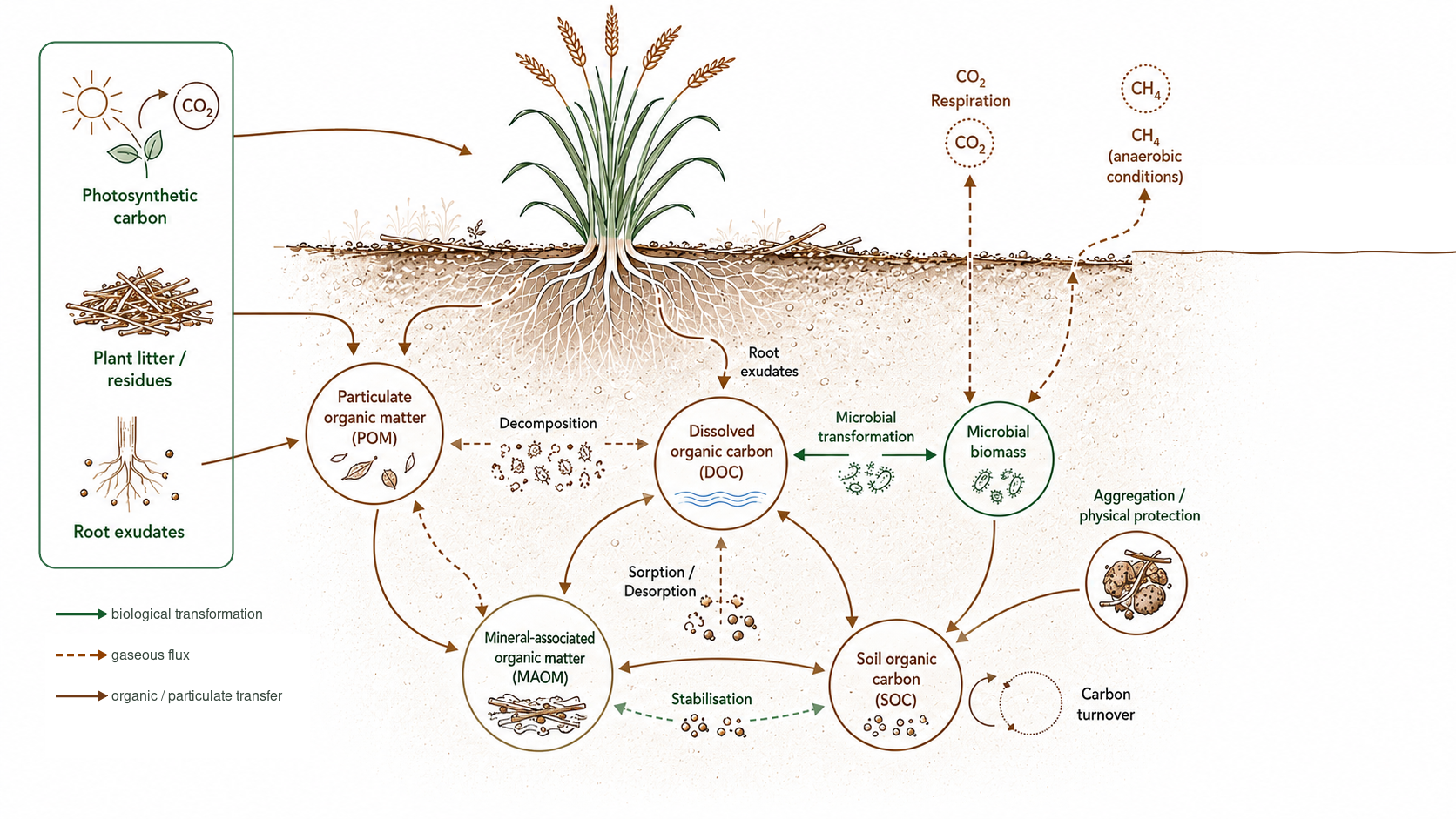
Hidden within that carbon stock measurement are faster-moving pools of carbon that respond to water, nutrients, weather, plants and microbes. This carbon flow is the lifeblood of soil productivity.

Diagram of soil carbon dynamics: photosynthetic carbon, plant litter and root exudates feeding particulate organic matter, dissolved organic carbon, microbial biomass, mineral-associated organic matter and soil organic carbon, with gaseous and dissolved carbon losses
Dissolved organic carbon sits at the centre of these exchanges. SensorC is developing its platform to detect this dynamic signal at the soil-water interface under field conditions.
Dark close-up of living soil showing earthworms, roots and decomposing organic matter

How to measure functional soil carbon?

We need to measure carbon flows, not just stocks.

Soil carbon stocks are not designed to measure and account for soil function. Carbon stocks change slowly relative to the many active soil processes that can be measured and managed by landholders.

…it may be the dynamic soil organic carbon pools with high potential rates of turnover that best offer resilience to ecosystems in the face of coming disturbances.
01

Why manage dynamic carbon pools?

Follow the carbon fraction that responds first.

Dissolved organic carbon is a mobile and biologically responsive fraction of soil organic carbon. It is exchanged among roots, microbes and the soil solution, and can change before a difference becomes detectable in the total carbon stock. Repeated measurement could provide earlier evidence of response to land management than stock measurements alone.

02

What is SensorC developing?

A dynamic carbon signal at the soil-water interface.

SensorC is developing an engineered electrochemical sensor to detect carbon signals in the moisture around soil particles, at the interface where roots, microbes and nutrients interact.

03

How should the signal be used?

In-field evidence, anchored to trusted analysis.

Periodic field sampling and laboratory analysis remain essential for establishing baselines and reporting against recognised carbon frameworks. SensorC is being developed to add repeated in-field observations between sampling events and provide ground-based context for spatial monitoring systems.

02 / NITROGEN

Nitrogen doesn't stay where we put it.

Nitrogen is the fundamental nutrient for growth and the one most easily lost between sampling events.

~190 Mt N

Applied to global croplands

~100 Mt N

Recovered by crops

52%

Global nitrogen-use efficiency

USD $75B+

Annual opportunity cost

What is soil nitrogen?

The fundamental nutrient for growth.

Productive soils require nitrogen in mineral or ‘plant-available’ forms such as nitrate or ammonium. Available nitrogen pools are increased by fertiliser inputs, atmospheric nitrogen fixation by legumes, or decomposing organic residues.

Aerial view of a vibrant green corn crop with neat rows stretching toward the horizon.

Photo: Antonio Duarte

The nitrogen opportunity

Around half of nitrogen inputs are lost from the system.

Global croplands receive approximately 190 Mt of nitrogen, but only 100 Mt is recovered by crops, a global nitrogen-use efficiency of roughly 52% (Ludemann et al., 2024). A 90 Mt nitrogen surplus is equivalent to nearly 196 Mt of urea, an opportunity cost worth over USD $75 billion.

Applied190 Mt N
Recovered by crops100 Mt N
Surplus90 Mt N

The nitrogen cycle in soil

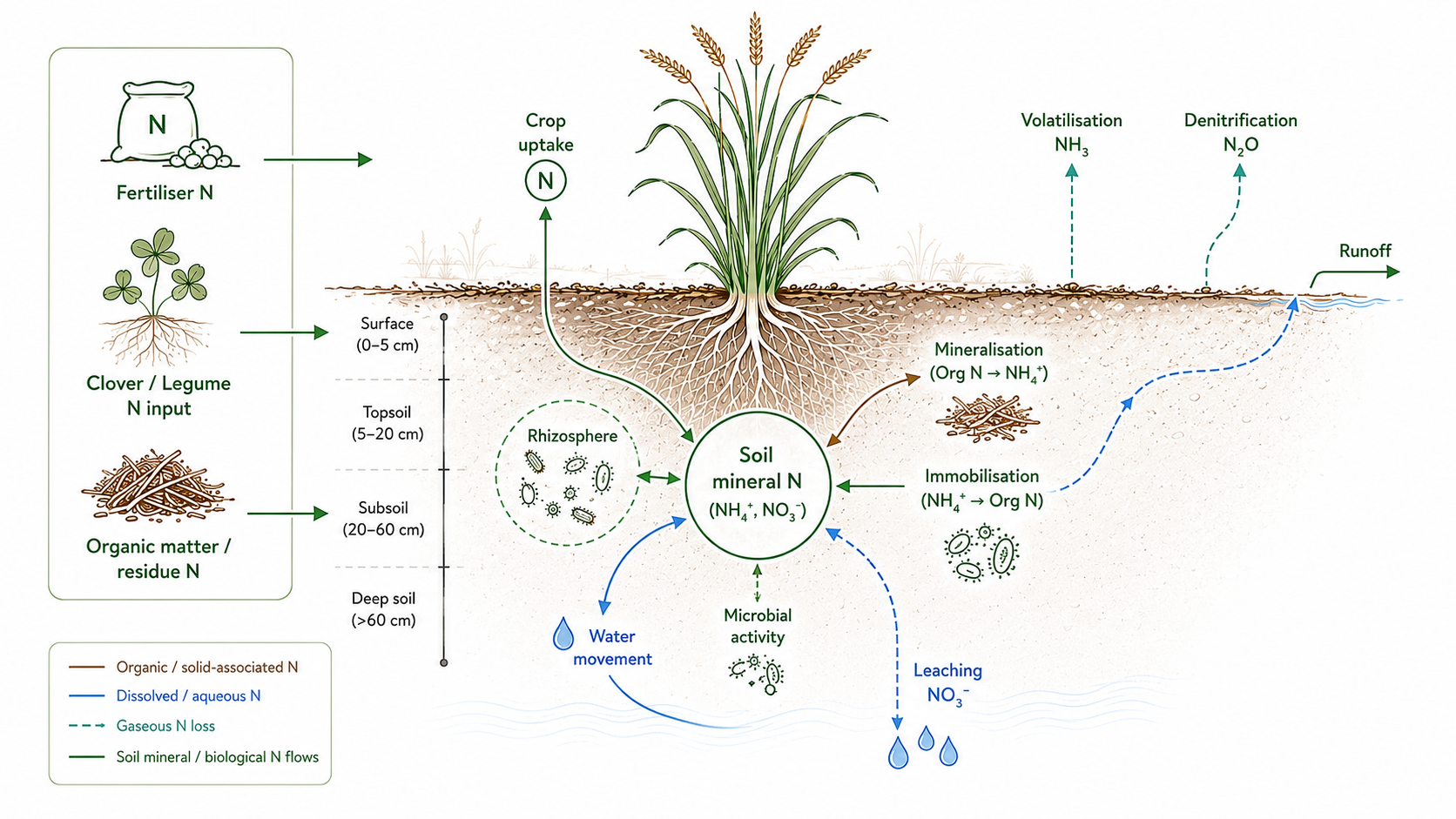
Available nitrogen pools in soil can change within hours, through plant uptake, microbial activity, leaching, and loss to the atmosphere. The challenge is knowing when this happens and how to respond.

Diagram of soil nitrogen dynamics: fertiliser, legume and organic matter inputs, crop uptake, microbial activity, mineralisation, immobilisation, volatilisation, denitrification, runoff and leaching
Repeated measurement at the soil-water interface could reveal nitrogen changes that periodic sampling may miss.
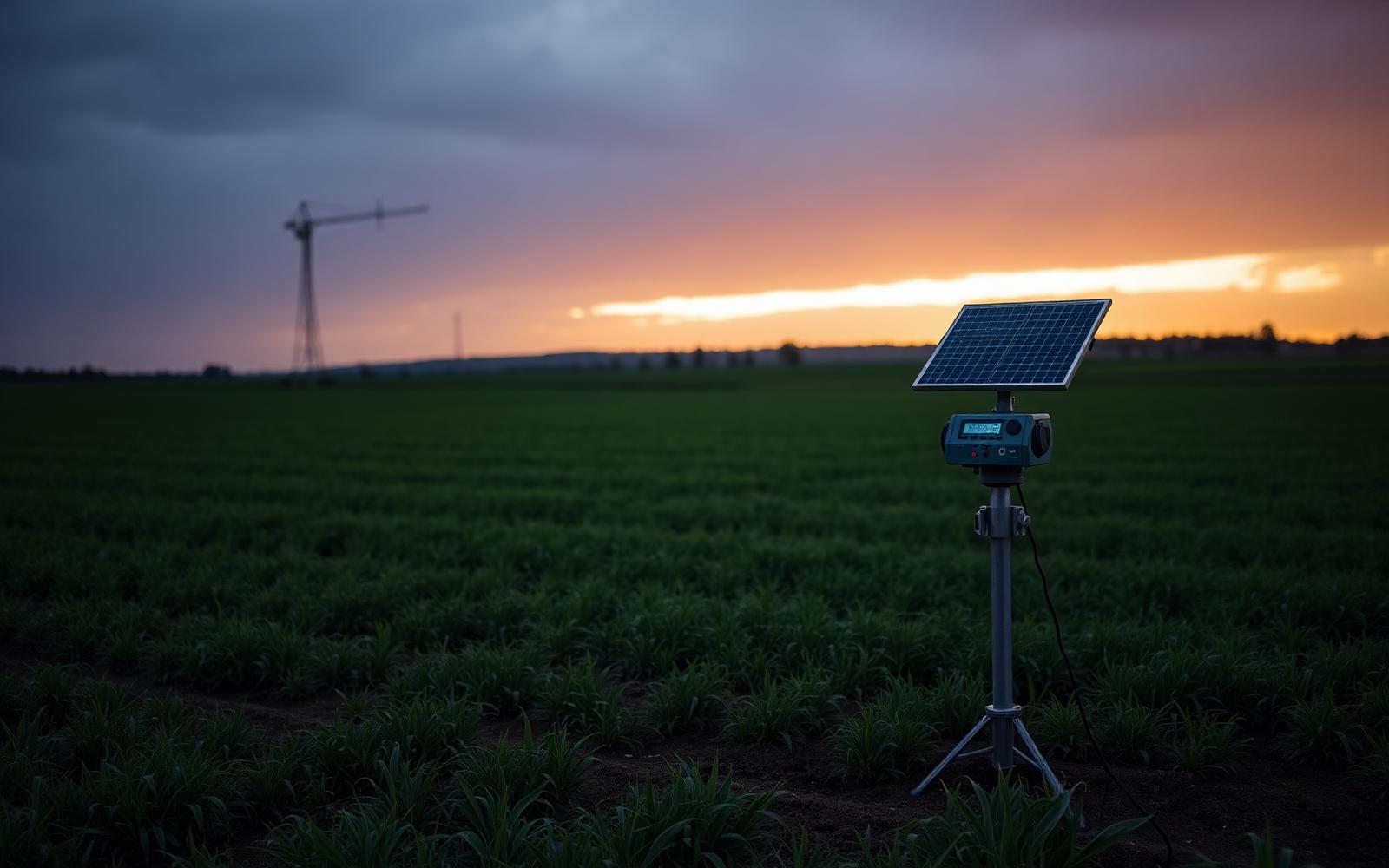
Solar powered soil monitoring station in a cropping paddock

Why measure nitrogen continuously?

Follow change between sampling events.

SensorC is developing continuous in-field measurement of available nitrogen. The aim is to show how nitrogen changes through the season and provide additional evidence for field trials and future agronomic decisions.

03 / From signals to decisions

Measure earlier. Decide sooner.

More frequent in-field measurement can show how soil conditions change between periodic samples and before final outcomes are known. This gives land and system managers more evidence to investigate change, assess an intervention and decide what to do next.

Fertiliser and soil management decisions are typically informed by episodic soil tests, broad budgets and seasonal assumptions. This makes it difficult to see how soil nitrogen and functional carbon respond through time or to assess the effect of management decisions as the season unfolds.

“The largest difficulty with N fertiliser management is the capacity to match N supply to crop demand.”

GRDC RiskWi$e, 2024

How the system fits together

Carbon and nitrogen. One connected system.

Nitrogen drives decisions

  • Nitrogen is fundamental to plant growth and yield
  • It is often the largest variable nutrient decision in agricultural production
  • Its rate, timing and placement shape both profit and loss

C:N connects carbon to nitrogen

  • C:N helps explain mineralisation and immobilisation
  • It helps interpret microbial activity and N release potential
  • It links soil health to nutrient availability

Carbon underpins soil function

  • Soil carbon stores energy and supports microbial life
  • Carbon helps drive aggregation, structure and water-holding capacity
  • It provides the biological context for nutrient cycling

Environmental monitoring

Track response and recovery over time.

Repeated ground-based observations can strengthen the evidence available to environmental monitoring, rehabilitation and recovery programs. SensorC is being developed to add temporal soil measurements between laboratory sampling events and alongside spatial monitoring.

Agriculture

Follow changing soil conditions through the season.

SensorC is being developed to provide repeated in-field nitrogen and functional-carbon signals for field trials, research and future agronomic decision-making. The platform is intended to complement laboratory analysis rather than replace it.